How many cameras and where: staggered heights, minimum simultaneous views and a subject leaving the scene
Rings of 3 to 12 IR monochrome cameras in a 6 × 6 m room
Simone Tortorella · October 2026
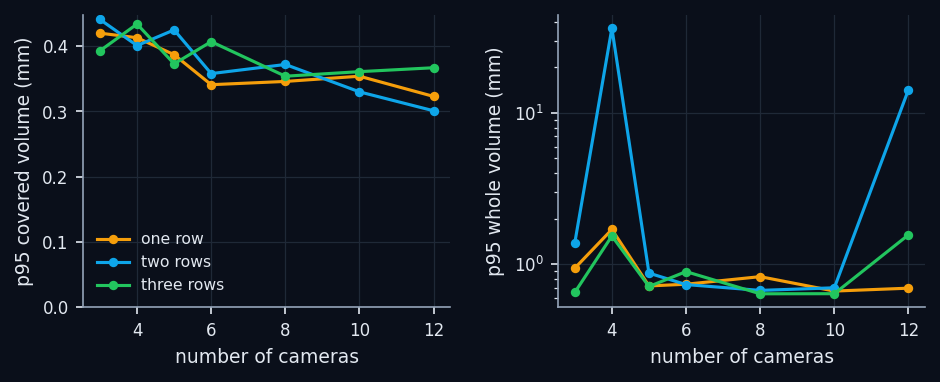
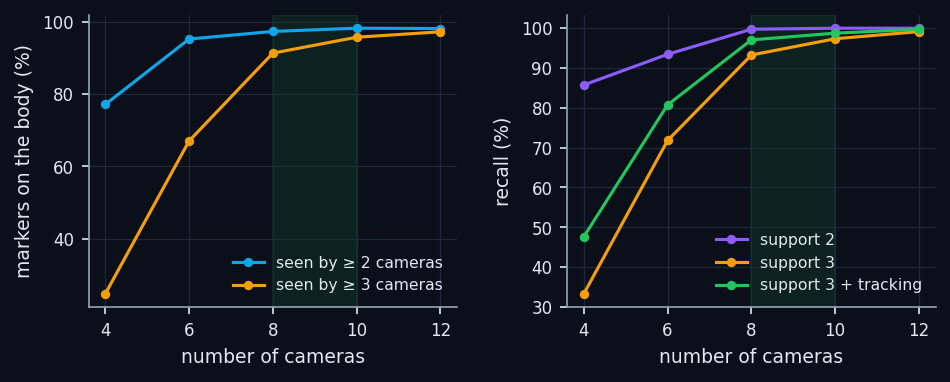
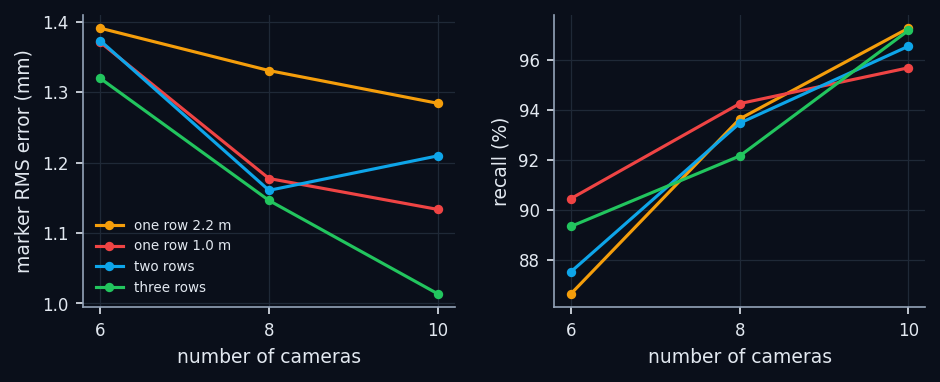
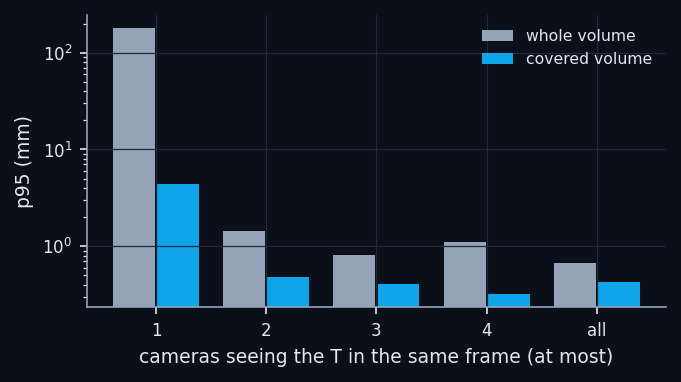
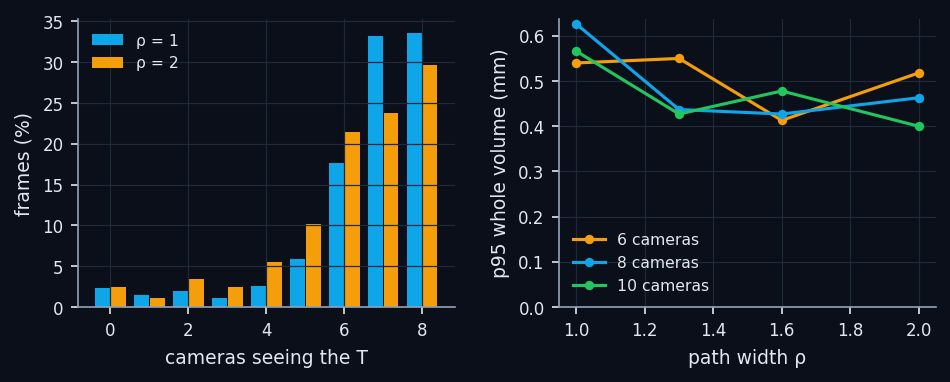
We study how many cameras are needed and where to place them for a 3.5×3.5×2 m volume in a 6×6 m room, with IR spherical markers and monochrome cameras. We separate two questions that are often mixed up: the quality of the calibration and the quality of the reconstruction of the markers on the athlete. Calibration with terna and T already works with 3 cameras and inside the covered volume it does not improve systematically with the number of cameras (p95 between 0.3 and 0.45 mm from 3 to 12 cameras). The number of cameras matters for reconstruction: the share of markers seen by at least 3 cameras goes from 25% with 4 cameras to 91% with 8 and 96% with 10, then flattens; the recall of reconstructed markers follows the same curve (97.0%, 98.7%, 99.7% with 8, 10, 12 cameras). The gain therefore converges between 8 and 10 cameras. Cameras staggered in height (two or three rows) reduce the reconstruction error by 10–20% compared with a single high row; the advantage comes mostly from the low cameras. Every image of the calibration object must be seen by at least 2 cameras at the same time (with 1 the calibration fails), better 3. If the subject leaves the volume the calibration does not get worse: frames in which the object is seen by fewer than 2 cameras simply do not contribute.
Keywords: number of cameras · placement · staggered heights · occlusion · simultaneous views
1. Introduction
In marker systems the question "how many cameras?" has two different answers depending on what is measured. To calibrate, there must be enough views of the calibration object to constrain every camera and link it to the others. To reconstruct an athlete, there must be enough cameras to see every marker from at least two (better three) directions despite the body covering it. Here the two questions are studied separately with the same simulator: 6×6 m room, 3.5×3.5×2 m volume, cameras on the walls evenly spaced along the perimeter, aimed at the centre of the volume, with the narrowest lens that frames it (always 120° in this room).
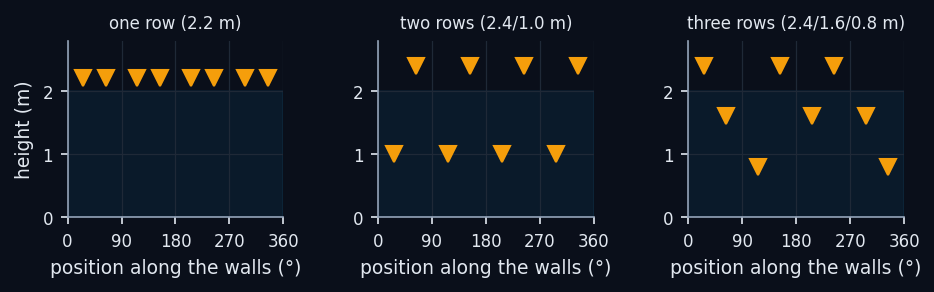
The heights tested are: all at 2.2 m ("one row"), all at 1.0 m ("low"), alternating 2.4/1.0 m ("two rows") and rotating 2.4/1.6/0.8 m ("three rows"). The starting hypothesis is that cameras staggered in height reduce occlusion and improve the triangulation geometry.
2. Calibration and number of cameras
3. Reconstruction: how many cameras see each marker
For reconstruction we use the scene of Paper 4: a person walking through the volume with 30 14 mm markers on the body, hidden by the body itself (capsule model), observed with 0.15 px noise and random reflections. We count how many markers are seen by at least 2 and 3 cameras and how many the triangulation algorithm for anonymous markers reconstructs (recall), with a minimum support of 3 views and tracking.
4. How many cameras must see the object at once
The bundle adjustment links the cameras through the frames in which the T is seen by more than one camera. To measure the minimum needed, in each frame we keep at most cameras (chosen at random among those seeing the T) and delete the observations of the others. With each camera sees the T alone: intrinsics remain constrained (as with a checkerboard), but the cameras are linked only by the terna.
5. The subject leaves the scene
In reality whoever moves the T leaves the volume, gets close to a wall, walks in front of a camera. We simulate this by widening the person's path by a factor (1 = always inside the volume; 2 = up to 0.5 m from the walls) and count in each frame how many cameras see at least 3 T markers.
6. Orientation and mixed resolutions
| Configuration | p95 (mm) | Note |
|---|---|---|
| 8 landscape cameras | 0,63 | whole volume |
| 8 portrait cameras | 0,59 | whole volume |
| 8 Full HD cameras | 0,43 | covered volume, 60 fps |
| 4 4K + 4 HD cameras, alternating | 0,36 | covered volume, 60 fps |
| 8 4K cameras | 0,29 | covered volume, 60 fps |
Portrait and landscape cameras are equivalent in an almost cubic volume. A mixed rig (half 4K, half HD) sits between the two homogeneous rigs: the bundle adjustment weights each observation by its expected error, so high-resolution cameras count more without special rules. Different frame rates between cameras instead require estimating a delay per camera (preliminary study) and were not simulated here.
7. Conclusions
- Calibration: 3 cameras are enough to calibrate; the number of cameras does not improve calibration, coverage of the volume and of every image's corners does.
- Reconstructing an athlete: minimum 6 cameras, optimum 8–10; beyond 10 the gain is < 1% of markers (98.7% → 99.7%).
- Heights: staggered on two rows (2.4 and 1.0 m) or three with 10 cameras or more: −10–20% error compared with a single high row; low cameras are needed for legs and feet.
- Simultaneous views of the T: minimum 2, recommended 3: move the T through the centre of the volume, where cameras overlap.
- The subject may leave the scene: frames with fewer than 2 views do not contribute and do not harm the calibration.
Limits: a single room type (6×6 m) and a fixed volume; wall-mounted cameras only; a simplified capsule body. In larger rooms lenses get narrower and markers bigger in pixels (Paper 1), but the reasoning on the number of views does not change.
References
- R. Hartley, A. Zisserman, Multiple View Geometry in Computer Vision, 2nd ed., Cambridge University Press, 2004.
- B. Triggs, P. McLauchlan, R. Hartley, A. Fitzgibbon, Bundle adjustment — a modern synthesis, LNCS 1883, 2000.
- T. Svoboda, D. Martinec, T. Pajdla, A convenient multicamera self-calibration for virtual environments, Presence 14(4), 2005.
- S. Tortorella, Paper 1 — Oggetto di calibrazione per marker IR anonimi, 2026; Paper 4 — Ricostruzione 3D di marker anonimi, 2026.